Dispute Resolution Services
Hand off dispute operations. Keep full accountability.
APS Dispute Case Processors manage the dispute lifecycle on your behalf all the way through resolution, using APS Advantage as the operational platform. You retain complete compliance enforcement, audit access, and case-level visibility. We carry the operational load.
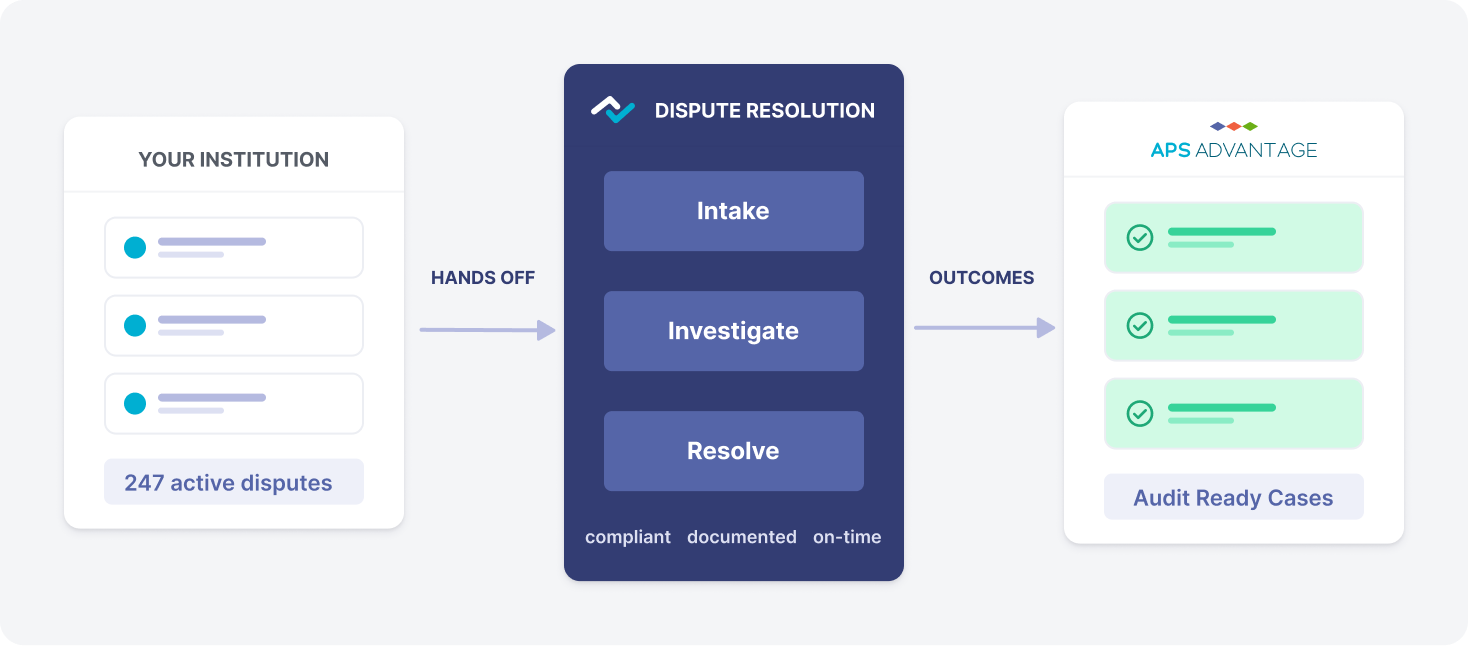
How APS Dispute Resolution (DRS) Works
You onboard with APS — importing data, configuring integrations, and mapping standards into the platform. APS Case Processors take it from there and work disputes under your program’s compliance requirements. Every case, every action, and every outcome lives in APS Advantage, visible to your team in real time.
You retain control of the policies. APS retains accountability for the execution.
When DRS Makes Sense
APS DRS is the right fit when the operational burden of disputes exceeds what your team can carry — or when carrying it introduces compliance risk you can’t afford. That looks different for every institution, but the signals are consistent: high turnover in dispute processing roles, compliance findings tied to manual error, or volume growth that keeps outpacing capacity.
DRS is also the right answer when the cost of building and maintaining an internal dispute team is harder to justify than the cost of partnering with one that already exists.
What’s Included in APS DRS
- Case triage and classification
- Investigation and documentation
- Provisional credit handling
- Reg E/Z required correspondence
- Fraud Reporting
- Representments and chargeback responses
- DRS Leadership bring 40 years of experience in Fintech.
- Built-in Reg E/Z rules enforced at the workflow level
- Standardized, immutable audit logs
- Consistent process enforcement across all case types
- Meet or exceed regulatory and network requirements
- Weekly and monthly performance reporting
- Full case-level transparency via APS Advantage
Which model fits your team?
Both options use the same platform and deliver the same compliance standards. The decision comes down to operational structure and where you want accountability to sit.